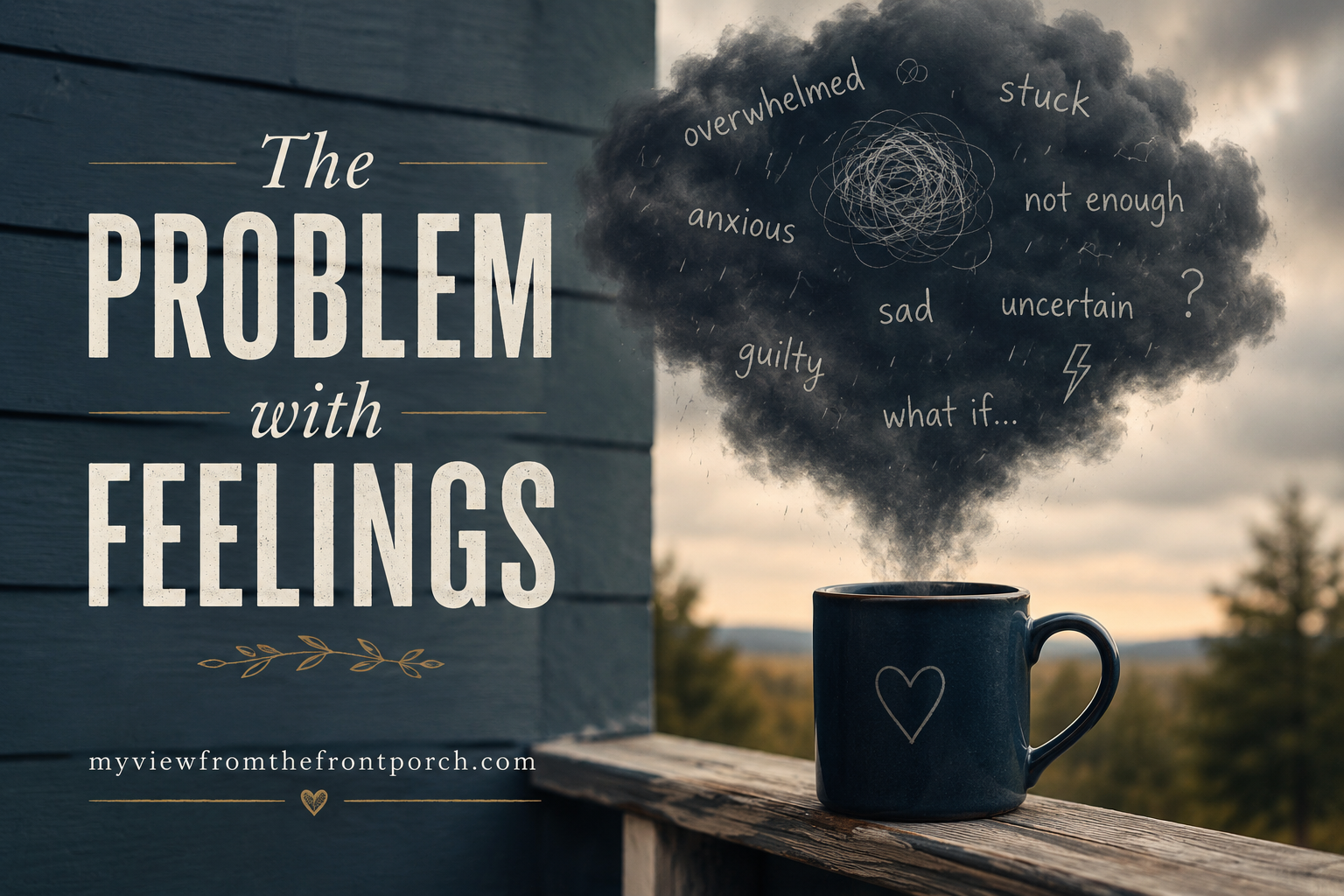
The Problem With Feelings
There was a time in America when facts mattered more than feelings. We may not have always agreed on policy, politics, or priorities, but at least most people accepted the idea that objective truth existed. Today, that foundation is cracking, and frankly, that ought to concern every one of us.
We are living in an increasingly feelings-driven society.
To me, that is terrifying.
Why? Because facts and feelings are not the same thing, and confusing the two has consequences.
Facts are grounded in logic, evidence, and reality. A fact is something that can be proven true or false. It does not care whether you like it. It does not adjust itself to spare your emotions. Gravity is a fact. Math is based on facts. Biology is based on facts. History, when honestly recorded, is rooted in facts.
Feelings are something entirely different.
Feelings are emotional reactions. They change from moment to moment. One day you feel optimistic. The next day you feel discouraged. Feelings are real in the sense that people experience them, but they are not automatically true simply because they are strongly felt.
That distinction used to be understood.
Now, increasingly, feelings are treated as equal to facts, or worse, superior to them. We hear phrases like “my truth” instead of “the truth.” We are told that questioning someone’s feelings is somehow cruel or intolerant, even when those feelings directly contradict reality.
That is a dangerous road.
According to Oxford Languages, a fact is “a thing that is known or proved to be true.” Clear enough.
The same source defines a feeling as “an emotional state or reaction,” and even includes “a belief, especially a vague or irrational one.”
Think about that for a moment.
A fact can be tested. Verified. Examined. Challenged.
A feeling cannot.
And that is exactly why feelings are so easily manipulated.
Politicians know it. Advertisers know it. Social media companies certainly know it. Fear, outrage, resentment, envy, and tribal anger are powerful emotional tools. Once people begin making decisions based primarily on emotion instead of evidence, they become easier to steer, easier to divide, and easier to control.
A population guided by facts asks questions.
A population guided by feelings reacts.
That difference matters.
None of this means feelings are unimportant. Human beings are emotional creatures. Compassion matters. Empathy matters. But feelings should inform our humanity, not replace our judgment.
If a bridge engineer “feels” the bridge is safe, but the calculations say otherwise, nobody wants to drive across it. If a doctor “feels” a diagnosis is right while ignoring the test results, patients suffer. In every serious area of life, facts eventually matter whether we acknowledge them or not.
Reality has a stubborn way of winning.
The problem today is that too many institutions, schools, media outlets, corporations, and political leaders encourage emotional thinking while discouraging critical thinking. People are rewarded for outrage instead of reason. Emotion spreads faster online than truth ever could.
And once society loses its grip on objective truth, everything becomes negotiable.
At that point, whoever controls the loudest emotions controls the conversation.
That should concern conservatives, liberals, and independents alike.
Because a nation that abandons facts in favor of feelings eventually loses the ability to govern itself rationally.
The Old Geezer
My View of the World from my front porch…